Laser Nanofactory
- Workstation for femtosecond laser multiphoton polymerization, selective laser etching and laser ablation processes
- High quality femtosecond laser with user required parameters
- Stitching error-free manufacturing over the entire working area (160 x 160 x 60 mm)
- Universal vacuum sample holder with computer-controlled and position-synchronized illumination
- Optical modulator and motorized attenuator for beam power control
- Powermeter for real-time power monitoring
- High sensibility camera for real-time process management
- Workstation is protected against environmental vibrations
- The system is compact and convenient, dimensions – 1.86 m, footprint – 1.14 m x 0.92 m.
- Laser Nanofactory weights about 700 kg.
- The laser safety of the system is Class 1 during the operation, when the main door is closed
- Laser Nanofactory has CE certification
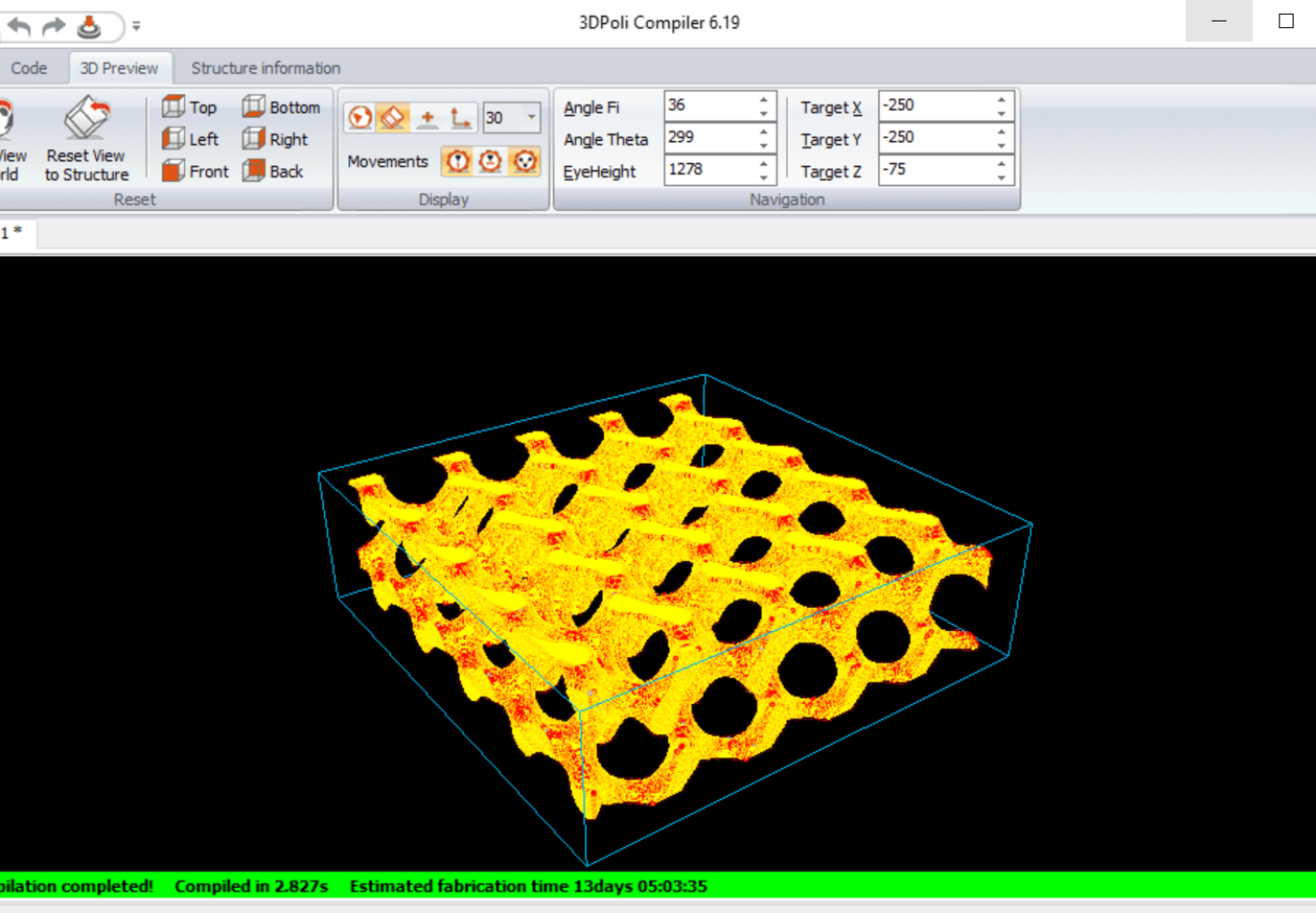
The software is divided into the two applications: 3DPoli Compiler and 3DPoli Fabrication. The Compiler is used for defining the structures (motion profiles). It does not require the system connected and can be easily copied to other computers (e.g. home computer) for convenience. The Fabrication part works only on a licensed computer with all the devices connected. It receives the compiled data from the compiler and performs the structure fabrication.
- The software allows direct power tunability through the laser and position-based pulse picker control.
- Precise control of several devices (Rotary, linear, piezo stages, galvanoscanner, power attenuator, laser shutter, etc.).
- The whole writing process is automated.
- Internal programming language.
- Automatic calculation of various structure parameters and estimated fabrication time.
- 3D fabrication trajectory preview window.
- An easy-to-use graphical user interface.
- The software has access to all necessary hardware parameters for controlling fabrication process.
- 3DPoli software handles standard formats of 3D designs created by popular CAD programs, like STL.
- Sample coordinate system alignment (tilting and rotation).
System is equipped with femtosecond laser of high beam quality (M2~1.2-1.3) and user-required wavelength (usually 1030 nm, 515 nm, 780 nm or can be dual-wavelength). Also, the average power of the integrated laser is selected based on desired customer application (from 250 mW to 40 W).
The ultra-precise positioning stages (resolution 1 nm @XY, 2 nm @Z; repeatability 75 nm @XY, 100 nm @Z; accuracy ±300 nm @XY, ±275 nm @Z) are synchronized with galvano-scanners, resulting in stitching-error-free manufacturing over the entire working field (160x160x60 mm) without sacrificing the speed or the quality.
This problem can be solved with synchronization of galvanoscanners and translation stages. This way the translation stages makes long and continous movements and galvanoscanners makes fast movements. As a result continous movement of working field is achieved, avoiding stitching and keeping very high fabrication speed and quality.
Laser Nanofactory is equipped with universal vacuum sample holder with computer-controlled, position synchronized illumination for transparent samples. Illuminated area - 14 x 66 mm (for microscope slide). Samples of different geometries (circular, rectangular and square) can be attached to the holder with vacuum. It has ability to easily change plates (porous ceramics) of sample holder for chucking the wafers. The design of sample holder can be customized due to specific needs of the client.
Additive manufacturing is based on 3D printing principle, multi-photon polymerization process. Microfabrication by multi-photon polymerization is a direct laser-write technique which allows 3D sturcturing of photopolymers at the micro- and nano-scale. This can be achieved through combination of various nonlinear effects, careful consideration of laser radiation parameters and precise focusing conditions. For this reason 3D laser lithography was used for creation of functional devices in fields of nanophotonics, microoptics, microfluidics, micromechanics, tissue engineering and much more. It is important to note, that there is huge variety of materials that can be processed by applying 3D laser lithography, including hybrid organic-inorganic photopolymers, biodegradable polymers, elastomers, proteins and so on.
Subtractive manufacturing is based on laser ablation and selective laser etching techniques.
Laser ablation based on ultra-fast interaction between material and femtosecond laser irradiation allows "cold processing" with minimal thermal effects and superb cut quality without damaging the surrounding material. Almost any material can be processed: metals, polymers, glass, even paper (banknotes, for example).
Selective laser etching is a two-step process. First, the volume of glass or sapphire is modified by ultra-short pulsed radiation, then the material is chemically etched away. In this way mechanically stable and durable structures can be created.
Laser Nanofactory system can be used for the treatment of surface areas - nano- to mili-patterning for enhanced surface repelling, adhesion properties.
Example applications:
.png) |
anti-bacterial, self-cleaning surfaces for medical implants; |
 |
surface friction reduction between parts of ship and water; |
 |
propellers and blades with anti-icing properties, reduction of friction between parts of airplane and air; |
 |
heavy machinery with heat dissipation, self-cleaning properties. |